

Blockchain Meets Healthcare: Wellgistics’ XRP Payment Revolution for U.S. Pharmacies
- Gator

- Aug 17, 2025
- 4 min read
Introduction
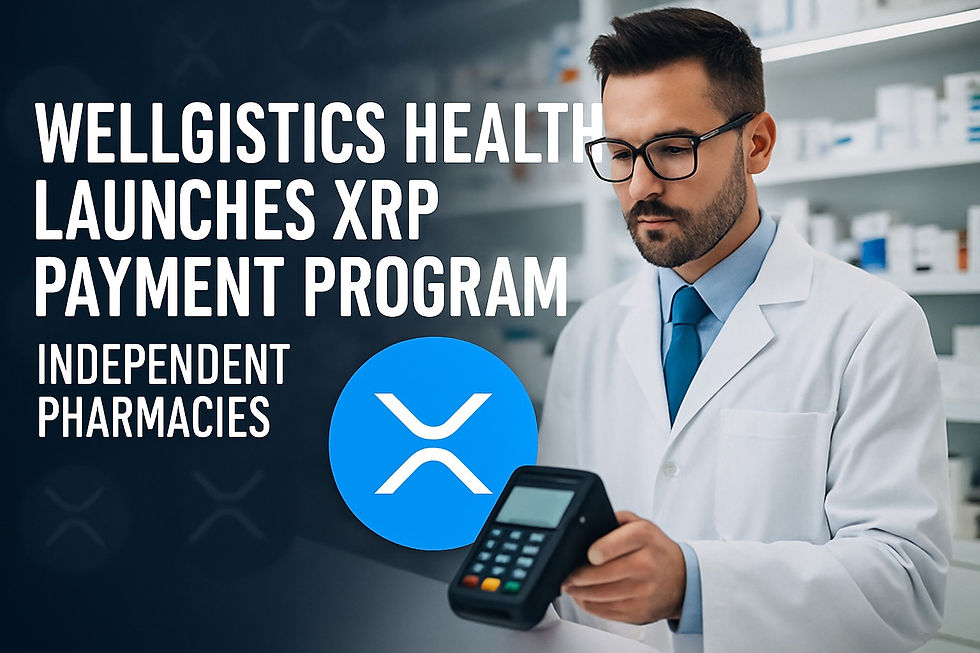
In a quiet corner of America’s $1.4 trillion pharmaceutical industry, a seismic shift is unfolding. Wellgistics Health, a Nasdaq-listed distributor serving over 6,500 independent pharmacies, has launched a groundbreaking payment system powered by Ripple’s XRP Ledger, announced on August 13, 2025. By enabling instant, low-cost transactions for prescription drug purchases, Wellgistics aims to dismantle the inefficiencies of traditional banking—days-long settlement delays, hefty credit card fees, and opaque intermediaries—that burden small pharmacies. Backed by a $50 million credit line and a partnership with RxERP, this initiative marks one of the first large-scale blockchain deployments in U.S. healthcare. Yet, as XRP’s price surges 500% to $3.11 and regulatory tailwinds fuel optimism, questions loom: Can Wellgistics deliver on its promise, or will volatility, compliance challenges, and market skepticism derail this bold experiment?
The Vision: Rewiring Pharmacy Payments
Wellgistics’ XRP Implementation Program, rolled out to 6,500 pharmacies and 200 manufacturers, harnesses the XRP Ledger’s speed—settling transactions in 3–5 seconds at a cost of less than $0.0002 per transfer, compared to $10–$30 for bank wires. Integrated with RxERP’s serialized e-commerce platform, the system offers real-time tracking, HIPAA-compliant data security, and AML adherence, ensuring pharmacies can pay for inventory instantly while bypassing banking delays. “Independent pharmacy owners are far more forward-thinking than people realize,” said CEO Brian Norton, emphasizing blockchain’s potential to empower small operators. The company envisions a future where XRP enables not just pharmacy payments but also manufacturer transactions and direct-to-patient shipping, streamlining a supply chain notorious for red tape. A beta program is live, with plans to onboard manufacturers by Q1 2026 and explore XRP-backed credit lines for pharmacies.
The Context: XRP’s Resurgence and Healthcare’s Blockchain Moment
Wellgistics’ move arrives at a pivotal time for XRP. Following Ripple’s August 7, 2025, settlement with the SEC, which clarified XRP’s non-security status for retail sales, the token soared 500% in nine months to $3.11, with 94% of holders in profit, per Glassnode. Institutional adoption is accelerating: Digital Wealth Partners raised $200 million in XRP for investment funds, and the CME Group plans cash-settled XRP futures in 2025. The broader healthcare sector is also warming to blockchain, with Grand View Research projecting the market to grow from $7.04 billion in 2023 to $214.86 billion by 2030. Prenetics Global’s $20 million Bitcoin treasury and Basel Medical Group’s $1 billion BTC reserve signal a trend Wellgistics is capitalizing on, positioning XRP as a bridge between fintech and healthcare.
The Promise: Speed, Savings, and Scalability
For independent pharmacies, often squeezed by thin margins and delayed reimbursements, Wellgistics’ system is a lifeline. Traditional payments can take 1–3 days to settle, tying up capital and delaying inventory restocks. XRP’s near-instant settlements and negligible fees promise improved cash flow, enabling pharmacies to restock faster and serve patients better. The system’s transparency—logging all transactions on the XRP Ledger—offers real-time compliance and auditability, critical in a sector governed by HIPAA and AML laws. Wellgistics’ $50 million equity line of credit, announced in May 2025, fuels its ambition to scale, with plans to integrate manufacturers and launch direct-to-patient programs, potentially revolutionizing how medications move from factory to patient. The company’s vision aligns with broader crypto trends, as seen in Mastercard’s 2025 report naming XRP a top cross-border payment solution.
Critical Challenges: Volatility, Compliance, and Market Realities
Despite its promise, Wellgistics’ initiative faces significant hurdles:
XRP’s Volatility: XRP’s 500% rally is a double-edged sword. While it boosts enthusiasm, the token’s 81% drop from its 2018 peak and 10–14% correction after a $175 million whale transfer in July 2025 highlight its volatility. Pharmacies relying on XRP for payments risk exposure to price swings, especially if fiat-to-XRP conversions are required, a detail Wellgistics hasn’t clarified. The article’s optimism glosses over this, assuming seamless adoption.
Regulatory Risks: While the SEC settlement cleared XRP for retail use, its security status for institutional sales and Ripple’s 40% supply ownership raise concerns. The U.S. Treasury’s digital ID proposal for DeFi, discussed previously, signals tighter scrutiny, and Wellgistics’ system must navigate evolving AML and HIPAA rules. The article underplays how regulatory shifts, like a potential SEC leadership change in 2028, could complicate compliance.
Market Struggles: Wellgistics’ stock (NASDAQ: WGRX) has plummeted 81% since its February 2025 IPO, closing at $0.65 with a $47 million market cap, reflecting investor skepticism. The company’s $28.99 million revenue pales against its $1.4 trillion market ambition, and its debt-to-equity conversion in August 2025 suggests financial strain. The article’s bullish tone ignores these red flags, framing Wellgistics as a pioneer without addressing execution risks.
Adoption Barriers: Pharmacy owners may hesitate to adopt XRP due to its complexity and crypto’s stigma in healthcare. The article cites Norton’s claim of “strong” response but lacks data on beta program uptake. Historical parallels, like Germany’s stalled blockchain healthcare pilots due to GDPR, suggest adoption hurdles, especially if pharmacies lack technical expertise.
Competitive Landscape: The article overlooks competition from other blockchains, like Ethereum’s $64 billion DeFi ecosystem or Solana’s high-throughput network, which could offer alternative payment rails. Ripple’s centralized control also draws criticism, with Custodia Bank’s Caitlin Long slamming XRP’s “backwards tokenomics” in August 2025, potentially deterring trust.
Broader Implications: Healthcare’s Blockchain Frontier
Wellgistics’ initiative reflects a broader shift in healthcare, where blockchain promises efficiency beyond payments. Decentralized science (DeSci) projects like VitaDAO are cutting drug development costs, while AI diagnostics firms like BitDoctor.ai streamline trials. However, challenges persist: Europe’s GDPR stalled blockchain pilots, and Asia’s $1.5 billion crypto crime wave, discussed previously, underscores security risks. The U.S.’s crypto-friendly policies under the GENIUS Act and dropped SEC cases provide a tailwind, but global disparities—EU’s MiCA, India’s proposed crypto ban—complicate cross-border adoption. Wellgistics’ success hinges on navigating these dynamics while proving XRP’s reliability in a risk-averse industry.
Conclusion: A Bold Bet with High Stakes
Wellgistics’ XRP-powered payment system is a daring leap, promising to unshackle 6,500 U.S. pharmacies from banking inefficiencies with instant, low-cost transactions. Backed by Ripple’s ledger and a $50 million credit line, it could redefine healthcare payments, aligning with XRP’s 2025 resurgence and broader blockchain adoption. Yet, XRP’s volatility, regulatory uncertainties, and Wellgistics’ financial struggles cast shadows. Pharmacies and investors must weigh the allure of speed and savings against the risks of a volatile asset and unproven execution. As Wellgistics eyes manufacturer onboarding and direct-to-patient programs, its ability to deliver will determine whether it leads healthcare’s blockchain revolution or becomes a cautionary tale.



Comments